

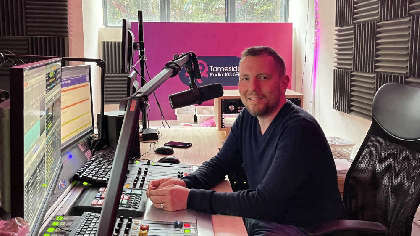
There has been quite a lot of discussion lately about the "right to switch off" from work being enshrined in law, and the new government has pledged to penalise employers who contact workers outside an agreed set of hours.
I've thought a lot about this recently, as I know people in my profession who still do radio shows whilst 'on holiday'. One friend of mine recently went to Florida, and was still doing a daily show from his hotel room. I'm not sure if he had a cocktail in hand from the pool bar whilst doing it, but I would question how healthy this situation is.
When I went away in April for six days, I didn't even take my smartphone, and I wrote in this newspaper at the time about how cathartic I found it. I enjoyed almost a week without a single E-mail, irritating notification ping, or indeed digital distraction of any kind, except for booking meals on the hotel app on my wife's phone. It was bliss, if I'm honest, but a lot of friends thought I must have lost my marbles.
The nature of work has changed in the digital age, and one of the reasons I love going to the cinema so much is that it prevents me from looking at my phone for a couple of hours. Admittedly, a few people do seem to think the bright glare of their screen is invisible to other cinemagoers mid-film, but most stick to the rule.
Remote and hybrid working patterns established during lockdown have done quite a lot to dissolve the boundary between work and home. A survey out this week shows that people who work from home spend more time sleeping and exercising than those who travel to work, saving an average of 56 minutes a day from not commuting, according to the Office for National Statistics (ONS). As a result of this time saving, home workers enjoy 24 minutes more of "sleep and rest" and 15 minutes of "exercise, sports and wellbeing" on any given day. No wonder there has been some resistance in some sectors at moves to get folk back to their desks.
More than one in four working adults in Britain describe themselves as hybrid employees, with the proportion of managers, directors and people in senior positions rising to 45%. Just 3% of those working in care, leisure and other services are hybrid employees.
In a separate development, NatWest Group has blocked messaging services WhatsApp, Facebook Messenger and Skype on company devices in the UK to 'stop staff using them to communicate with each other'. The BBC reports that the bank had already told employees to stick to so-called "approved channels" for conversations about business matters, but they have now taken things a step further.
Messages of course can be difficult to retrieve or even set to disappear, as we found out during the Covid enquiry, when around five thousand messages from a certain former Prime Minister currently to be found flogging his book mysteriously vanished into the ether. Exceptionally convenient, one could argue. At the time, he said: "I don't know the exact reason, but it looks as though it's something to do with the app going down and then coming back up again". Seems legit to me. Nothing to see here. Move on and buy my book.
I can understand calls for the right to switch off, and perhaps we would all benefit from re-establishing more of a separation between work and home life. It was reported back in August that the UK banking regulator, the Financial Conduct Authority, is considering an enquiry into how bank workers are using messaging services. This follows a large fine imposed on Morgan Stanley by Ofgem over calls made on private phones over WhatsApp, which breached strict rules on record-keeping. You have to question if it's an appropriate medium for government business to be conducted.
As for whether the "right to switch off" is something that should be written into law, I guess this is something that can be debated in Parliament. It seems to work in Belgium, Spain and Italy, where laws are already in place. We are all more productive with a good work life balance, and I doubt many people wish at the end of their life that they had spent more hours working, however much you love what you do. With that in mind, I'm going to make a pot of tea and run a Mr Matey bubble bath.
 Alex Cann Column - 05/03/26
 Alex B Cann column - Sit down to put on your socks? You're officially old! 26/02/2026
 Alex Cann's weekly blog - 9th January