
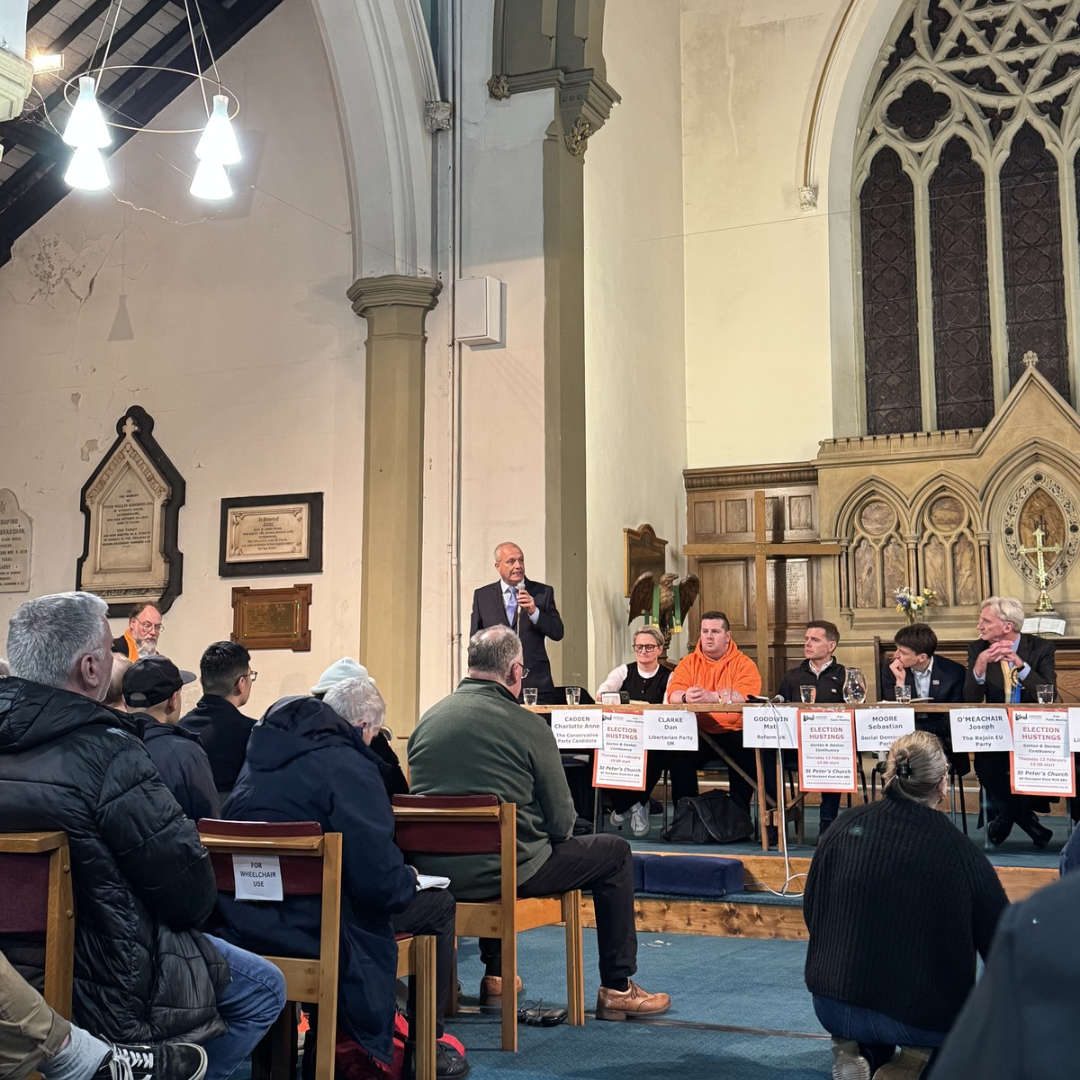
A lively and at times fractious hustings ahead of the Gorton and Denton by-election drew a packed audience to Levenshulme on Thursday night.
Hosted by Levenshulme Community Association at St Peter’s Church on Stockport Road, the question time-style event gave residents the opportunity to put their concerns directly to candidates contesting the poll on 26 February. Each hopeful was given two minutes to introduce themselves before taking questions from the floor.
Ten of the eleven candidates standing in the Gorton and Denton by-election took part in Thursday night’s hustings, with representatives from Labour, the Conservatives, the Liberal Democrats, the Green Party, Reform UK, the Social Democratic Party, Rejoin EU, the Communist League, Advance UK and the Libertarian Party all in attendance. The only candidate not present on the night was Sir Oink A-Lot of the Official Monster Raving Loony Party.
The evening began with raised eyebrows and audible reactions from the audience. Reform UK candidate Matt Goodwin was laughed at during his introduction after telling the room he was from Manchester. Advance UK’s Nick Buckley was later booed when he said “we should have one community the English, the British community where we live together in harmony”, prompting a shout of “shame” from the audience.
There were also sharp exchanges between candidates. Green Party hopeful Hannah Spencer challenged Mr Goodwin over a blog post she said he had written suggesting women who do not have or want children should be taxed more. She accused him of hypocrisy given his stated support for women’s rights. Mr Goodwin responded that the claim was “false information spread by the media”.
Traffic, pollution and road safety were among the first issues put to the panel, reflecting ongoing concerns in Levenshulme and across the constituency about air quality and pedestrian safety.
Angeliki Stogia for Labour pointed to her work locally and regionally, saying she had worked with Greater Manchester Mayor Andy Burnham to deliver the Bee Network and bring buses back under local control. She also referenced her involvement in pushing for improvements at Levenshulme station and in implementing clean air measures. If elected, she said, she would “champion and deliver actions on the ground” to improve air quality, reduce congestion and make streets safer.
Green candidate Hannah Spencer spoke about the visible impact of pollution, recalling having to wash “grey coating” from her windows when living near a busy road. She highlighted Manchester’s commitment to a Vision Zero strategy to eliminate road deaths and argued for better public transport and safer cycling infrastructure. “We need people who believe in the science,” she said, adding that poorer communities were often worst affected by pollution.
Liberal Democrat Jackie Pearcey described monitoring pollution levels outside her own home, saying readings were frequently in the “danger zone”. She called for more trams to this side of Manchester, better road design to protect cyclists and pedestrians, and action on particulate pollution, including from wood-burning stoves.
Rejoin EU candidate Joseph O’Meachair focused on the role of international standards in reducing air pollution over recent decades. He argued that adherence to high standards had driven improvements and said similar principles should be applied to transport and environmental policy.
Sebastian Moore of the Social Democratic Party, who said he cycles everywhere, called for better-designed cycling infrastructure but cautioned against “punishing car users”. He criticised some low traffic neighbourhood schemes as poorly consulted on and said investment and productivity were key to improving transport.
Conservative candidate Charlotte Cadden highlighted her party’s past investment in rail and support for the £2 bus fare cap. While backing public transport, she said the Conservatives were “not anti-car” and would scrap carbon taxes and support petrol and diesel vehicles beyond 2030.
Reform UK’s Matt Goodwin criticised the handling of major infrastructure projects, saying he did not believe HS2 represented value for money. He argued that funding should instead be directed into local transport links and said he wanted to support grassroots campaigners, including those working on air quality.
Communist League candidate Hugo Wils framed transport problems as rooted in “fundamental social relations”, arguing that meaningful change would only come when working people had control over production and investment decisions.
Libertarian Party candidate Dan Clarke said he would seek to work with political leaders and private enterprise to improve transport, stressing the need to balance better public transport with the needs of car users.
Advance UK’s Nick Buckley said better integration between buses, trams and trains was long overdue, contrasting Manchester’s system unfavourably with London’s and arguing that long-term planning had been lacking.
Fly-tipping and environmental crime sparked similarly passionate responses.
Labour’s Angeliki Stogia said she was “very passionate” about the issue and pointed to additional national funding to tackle neighbourhood crime. She said councils needed greater powers and resources to prosecute offenders and pledged to fight for a share of funding for Gorton and Denton.
Jackie Pearcey recounted a case in which a perpetrator who had dumped large quantities of waste was fined just £25, calling for tougher penalties and proper resourcing. She said patterns of repeat dumping were known and needed targeted enforcement.
Hannah Spencer argued that fly-tipping was often a class issue, with poorer areas disproportionately affected and residents targeted by rogue traders. She called for more funding for councils and stronger housing standards, including action against rogue landlords.
Nick Buckley distinguished between individual littering and professional fly-tippers, blaming the local Labour-run council for failing to keep streets clean and calling for much higher fines for commercial offenders.
Charlotte Cadden said swift enforcement was essential to prevent areas declining, while Sebastian Moore and Dan Clarke both stressed personal responsibility alongside enforcement measures.
Hugo Wils again linked the problem to wider social and economic structures, arguing that greater community control was needed.
With audible reactions throughout the evening, Thursday’s hustings underlined both the strength of feeling locally and the wide ideological spread of candidates competing to represent Gorton and Denton when voters go to the polls on 26 February.
 Tintwistle Bowling Club community open day
 Progress on new outdoor market
 SEND school in Royton told to urgently improve
 How people in Hyde feel going into local elections