
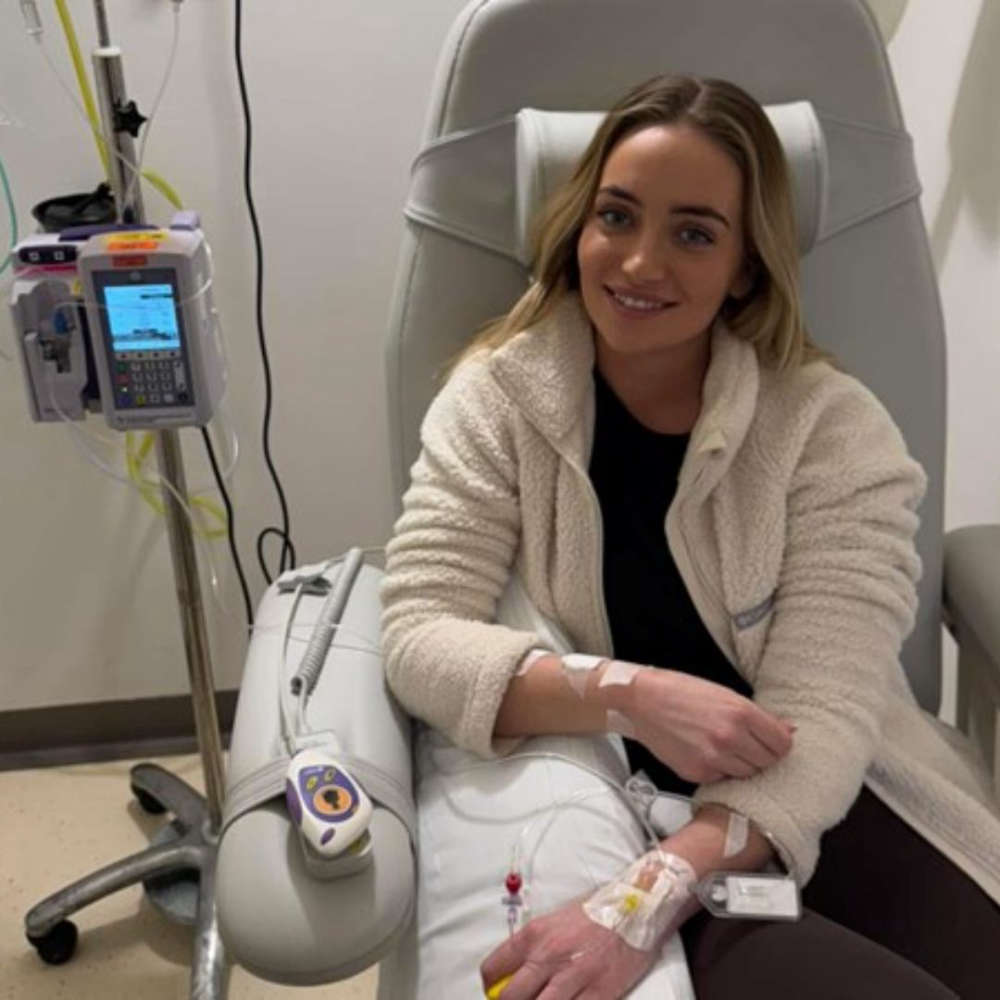
When Chelsea Tantum walks into a room today, she looks like any other young woman from Hyde enjoying life. Just a year ago, she was on palliative care, in a wheelchair and on a syringe driver of morphine, told there was only a 40–50 per cent chance that her cancer treatment would work as melanoma spread through her body.
Chelsea’s story began as a teenager, when she started using sunbeds because “the girls the year above” at school were doing it and talked about getting a “base tan” before holidays. Despite age restrictions first set at 16 and then raised to 18, she continued using them, drawn into what she now calls a “whole culture” of tanning, accelerator creams and even tanning injections.
Years later, a mole on her leg was removed and diagnosed as a primary melanoma. By the time she was escalated through dermatology, she was already stage 3C the cancer had spread to lymph nodes in her groin, a level of seriousness she admits she never associated with “just skin cancer”. “I actually said it’s not proper cancer,” she recalled.
Major surgery followed, including removal of a large area of tissue from her leg, a skin graft and the removal of all lymph nodes in the limb, leaving her with lymphedema, mobility issues and severe scarring that she says looked like a “shark’s bite” out of her leg. “As a young girl, being faced with the rest of my life with these awful scars was really difficult,” she said, though those worries faded as the disease worsened.
Before she could even start preventative treatment, scans showed melanoma had already spread to her lungs. Within four to six weeks it was in every vertebra of her spine, all her ribs, both pelvises and femurs, her lungs, liver, spleen, breast and more lymph nodes, as well as behind her knee. Her blood markers suggested the cancer was doubling every day.
Chelsea was placed on palliative care, given high doses of morphine and anti-sickness drugs via a syringe driver and visited daily by district nurses and a palliative care nurse. She became too weak to walk and relied on a wheelchair. “I was dying,” she said bluntly.
The physical decline was matched by a collapse in her mental health. A doctor visiting at home prescribed antidepressants as she struggled with the possibility that she might not survive, began thinking about her funeral, and admits there was a point when she simply “didn’t want to keep suffering any longer”.
Then, on 1st May 2025, something shifted. After weeks of barely leaving the house, she asked a friend to take her out, despite still being extremely weak and in a wheelchair. “From that day on I went out every single day, the sun was shining and I got my fight back,” Chelsea said, she started eating again, gradually reduced her syringe driver medications and began to regain strength.
Over May and June, photos charted her daily improvement as she moved from being unable to take two steps to climbing stairs on her own within days, a remarkable recovery driven by immunotherapy treatment. The treatment itself was tough and brought a lot of side effects but thankfully Chelsea did see a positive response to the treatment, something that is only 40-50% likely to happen. Scans every three months brought a run of good news, by November, disease had cleared from her bones and most organs, and only a few spots remained in her liver. Her oncologist at The Christie described the turnaround as nothing short of a “miracle”.
Chelsea hoped to celebrate her 30th birthday with an all-clear. A February body scan did show no remaining disease in her organs, but a routine MRI revealed 10 nodules in her brain, pushing her diagnosis to stage 4D melanoma. She remains on immunotherapy every four weeks and recently completed stereotactic radiosurgery (SRS) to target the brain lesions.
Now in what she calls the hardest phase, the waiting, or “scansiety” she faces months before her next scan, hoping to see the brain nodules shrinking or becoming inactive. “We just pray for that news,” she said.
Far from retreating, Chelsea has channelled each setback into action. Expecting an all-clear for her 30th but instead being told the cancer had reached her brain, she decided to raise money for Melanoma Focus, a charity which produces much of the patient information given out at The Christie. Aiming for £500 on her JustGiving page, she has already raised nearly £4,000, well above her original target of £500.
She has also become a vocal campaigner for sun safety. To explain melanoma, she uses the image of a dandelion, the visible mole is the flower, but once it’s picked, unseen “seeds” can drift anywhere in the body just as her disease spread from a mole on her leg to vital organs and brain.
Chelsea urges people to take sun protection seriously, pointing to the Melanoma Focus website for guidance on checking moles and applying sunscreen properly. She admits she used to apply cream once and forget about it, but now stresses it should be “lathered on” and reapplied every two hours and even more often in and out of swimming pools.

She is particularly stark about sunbeds, calling them a type 1 carcinogen “exactly the same as smoking is for lung cancer” and insists there is “absolutely no way of tanning on a sunbed safely”. Citing figures that 43 per cent of 18–25-year-olds and a third of 16–17-year-olds use sunbeds despite it being illegal for the younger group she says: “If I could have a time machine and go back 15 years and never use a sunbed, then I absolutely wouldn’t.”
Statistics, she says, are only part of the picture. One commonly quoted figure is that getting sunburnt five times before 35 can increase the risk of melanoma by 59 per cent, but she believes hearing from a real person living those numbers hits harder than any leaflet. “I am one of those stats. This is me and this is my life,” she told listeners.
Her advocacy has already taken her to a national Melanoma Patient Conference, where she shared her story with around 230 other melanoma patients and into schools. At the request of a sixth-form teacher concerned about students’ sunbed use, she and a nurse from The Christie are visiting a local college to “bring those facts and stats to life” for teenagers who may see tanning as harmless.
Despite everything, Chelsea’s focus is outward. “If my experience can help just one person not have to go through what I’ve been through, then I feel like it’s really worthwhile,” she said. For
now, she continues treatment, waits for her next scan, and keeps talking, hoping her warning reaches someone before they step into a sunbed or out into the sun unprotected.
There’s more information on Melanoma via https://melanomafocus.org/
 Pedal power for Tameside and Glossop neonatal team
 Residents invited to shape £1.3m Pride in Place funding across Tameside
 Advertorial: Audenshaw family business still rolling after nearly 70 years
 Unused factory building could be transformed into new homes