

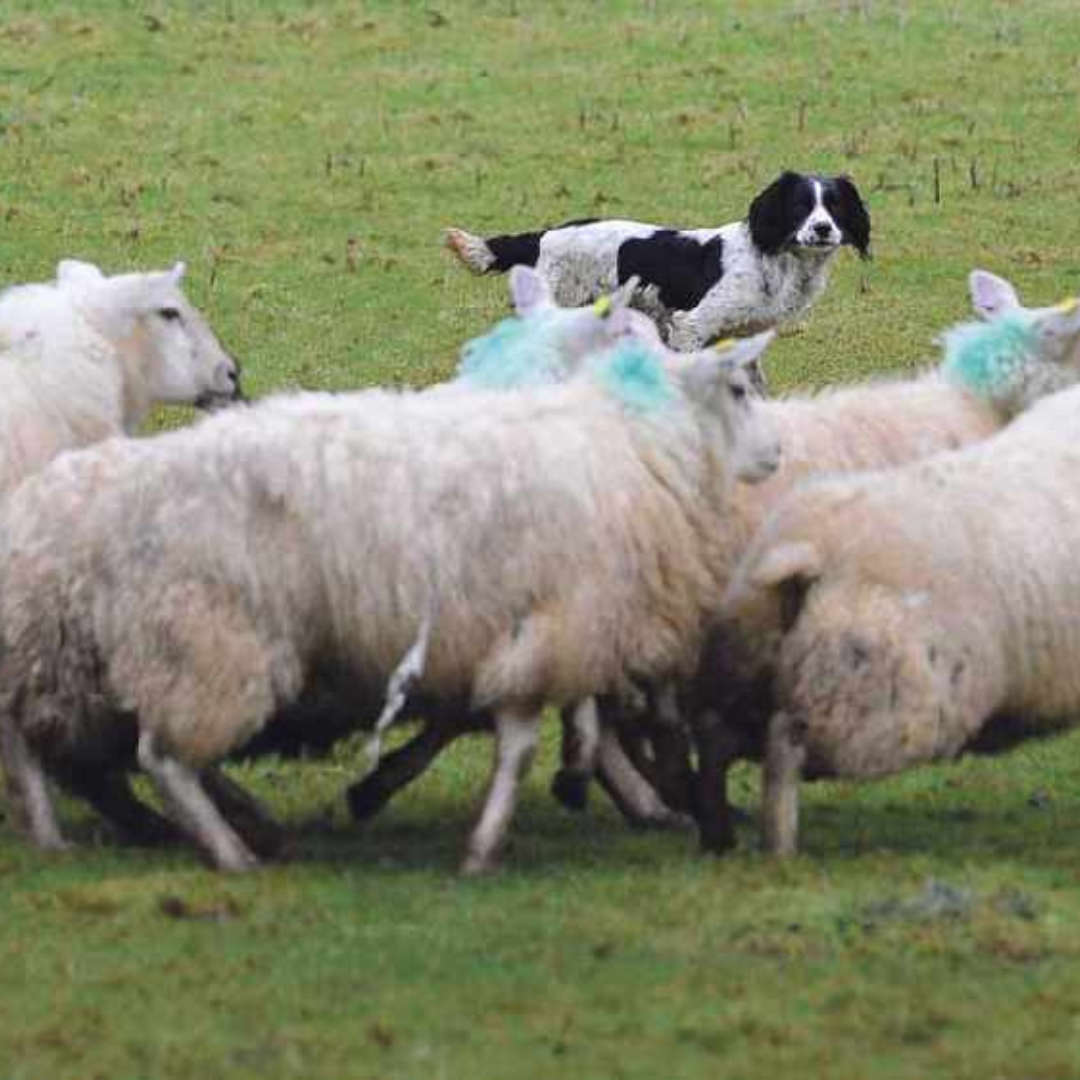
Dog owners whose pets worry sheep are facing “unlimited fines” under tough new rules to protect country livestock.
And updated legislation will give police new and strengthened powers in their investigations.
Now in support of beleagued members, the National Sheep Association have issued the changes in the law defining livestock worrying by dogs.
They say: “If a dog attacks or worries livestock on any agricultural land or on a road or path, the owner of the dog, and, if it is in the charge of a person other than its owner, that person also, shall be guilty of an offence.”
Agricultural land means land used as arable, meadow or grazing land, or for the purpose of poultry farming, pig farming, market gardens, allotments, nursery grounds or orchards.
“And “livestock” means cattle, sheep, goats, swine, horses, camelids or poultry, and “cattle” means bulls, cows, oxen, heifers or calves, “horses” includes asses and mules, and “poultry” means domestic fowls, turkeys, geese or ducks.”
And “worrying livestock” means “chasing livestock in such a way as may reasonably be expected to cause injury or suffering to the livestock or, in the case of females, abortion, or loss of or diminution in their produce” or “being at large (that is to say not on a lead or otherwise under close control) in a field or enclosure in which there are sheep.”
The NSA say this essentially means in the majority of cases where livestock, particularly sheep, are attacked or worried by a dog or dogs, the owner or person in charge of dog(s) will be guilty of a criminal offence and capable of prosecution.
The new addition of road or path is especially helpful for sections of land which may not strictly fall into the definition of ‘agricultural’ but are nonetheless part of the farm and which are subject to public footpaths, as many livestock farms are.
The separation of ‘attacks’ from ‘worries’ appears at first blush to be a technical change, given ‘attacking’ was previously incorporated in the definition of worrying. However, it is actually an important distinction which ensures that persons in charge of dogs who cause their dogs to attack livestock which are trespassing on a road or path, can still be prosecuted.
Livestock straying from their fields are therefore partially covered by the amendments. However, where livestock have strayed and are trespassing, if they are chased, but not attacked, then the dog owner may have a defence against prosecution.
The amendments have strengthened powers for the police to enter premises and seize and detain dogs suspected of livestock worrying both when found without its owner or a person in charge of it and later where they have reasonable grounds to suspect a dog which has been involved in worrying is living.
One important and new police power provided by the Act is the power to collect samples and impressions from both the suspect dog and the worried livestock.
In the case of worried livestock, where necessary the power is provided by a vet to obtain the sample or impression where to do so would amount to veterinary surgery. This will allow a greater chance of conviction as the evidence will be greatly strengthened. The majority of livestock worrying cases are not pursued by the police due to lack of evidence.
The Act also requires the police to keep a register of all dogs seized for livestock worrying and for that register to be available for public inspection. This should hopefully assist in keeping the police accountable and helping to track livestock worrying cases.
Although no sentencing guidelines have yet been released fines will usually be based on the offender’s income, their culpability in the offence and the harm caused. This could result is some very large fines, which will hopefully act as a stronger deterrent to dog owners and walkers in rural areas.
In addition to fines, those found guilty of a livestock worrying offence can also be required to pay compensation under a compensation order. Under the new amendments, any costs of seizing and detaining the dog will be payable by the defendant under a compensation order, along with any compensation applied for by the farmer whose livestock have been worried.
 Council leader backs government's new definition of anti-Muslim hostility
 Dovestone Diamond Multi-Terrain Race back
 Opening date of Oldham’s new market announced
 Why more local families are turning to home education