

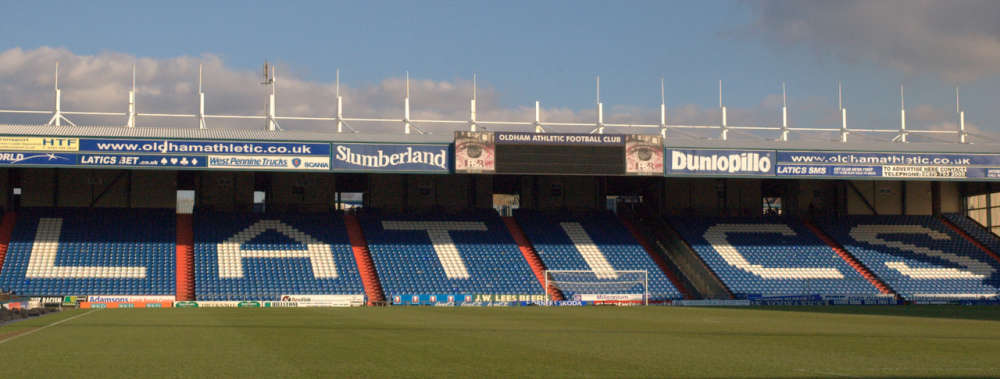
The Latics bus travelled south today ahead of tomorrow’s early kick-off against Barnet. The sides shared the points earlier in the season, but the truth is that Latics absolutely battered them right up to the point where there was only one more thing to do: score, put it in the onion bag, register.
When the scores were level at 1-1, Barnet keeper Cieren Slicker saved three one-on-ones – two from Michael Mellon and one from Kane Drummond. It was the lowest point of Latics’ finishing woes this season until Chesterfield at home on new year’s day, when a saved penalty was somehow only the third-worst miss of the afternoon.
Mark Shelton, the Barnet midfielder, had an interesting return to Boundary Park in September and packed a lot into his 17-minute cameo. He was booed from the outset by Latics fans for being one half of Latics’ invisible central midfield two seasons previously, scored a penalty after five minutes, got booked for celebrating in the faces of the Jimmy Frizzell furies, came a distant second in a clash with Ryan Woods and went off injured.
Barnet and Latics, the two sides promoted from the National League last season, are more than holding their own in League Two. They are level on points in 12th and 13th, stalking Notts County in the final play-off place from a distance of seven points plus goal difference.
The season isn’t quite at the point where both sides need the win to stay in touch, but it isn’t far away. Latics will create chances. The question is whether they can put them away.
WILL SUTTON HAS LEFT THE BUILDING
Will Sutton, the 23-year-old Latics defender, was loaned to National League side Solihull Moors this week after another stop-start season with Latics. The move potentially gives Latics headroom for loaning someone in, but there is widespread disappointment at Latics’ only homegrown player leaving, just has there been disappointment that he has not been a permanent fixture in the squad, let alone the first XI.
Sutton had a good start to the season but has started only one game since his controversial dismissal against Salford City in October, and has even been in and out of the matchday squad of 18. Two weeks after Sutton’s sending off, Micky Mellon signed Dynel Simeu to add to his options on the right side of the defence, making Sutton the fifth choice behind Jake Caprice, Donervon Daniels, Reagan Ogle and Simeu.
This is not big news in and of itself, but it is big news in the context of the Mellon contract talks and the club’s immediate and longer-term direction of travel.
Mellon marked the move with a written statement on the club website: “Will is at a stage in his career where regular first-team football is really important. This loan is an important step as we look to support his development to the next stage. It will give him the chance to play games, test himself and continue progressing. We’ll be keeping a close eye on him and wish him every success during this loan.”
These platitudes come with any loan that doesn’t have a disciplinary edge to it (such as Alex Reid to Wealdstone) and, put bluntly, it’s not good enough. It tells us nothing, which is a club public relations objective, and it gives rise to a great many questions to which fans are entitled to answers. Here are some of those questions:
Why use the extremely tight budget to extend the Simeu loan to the end of the season when not doing so would give Sutton, a contracted saleable asset, a better chance of regular first-team football with Latics?
Why, if the club aims to open a nurture-and-sell revenue stream, is the club’s only homegrown player going down a division on loan?
What does it say to potential Academy recruits for next season and beyond?
If the Academy-first player recruitment strategy is for tomorrow, what do you mean by tomorrow?
Mellon is painting the move as a development opportunity, but that’s not the sense you get from Sutton’s statement to the Oldham Times. “I’m buzzing to finally get it done. Having known the gaffer” – meaning Solihull boss Chris Millington – “when I was a youth team lad at Oldham, it’s something I’m very excited about and I can’t wait to get going.”
The fella sounds as if he has escaped jail. We know from Mellon’s management book “The First 100 Days” that he is not averse to casting people out into the wilderness when he doesn’t rate them. We know he is absolutely myopic about picking sides based on whom he believes will win him a game of football. Is that what’s happening here? Can Mellon say anything about why he favours four older right-sided defenders over Sutton, or has he already said it?
Sutton is going to a club where he will get minutes in his legs (you can’t be wasting time when you’re 23), and he will work with a friendly face from his happier past – Millington – so I’m not surprised he’s delighted to get out, having seen himself fall to fifth in the pecking order on the right of defence. In any case, Sutton has played many, many more minutes out of his natural position (centre-half) than in it. Is this what our future Academy lads can expect? The manager doesn’t rate you when you play out of position, so you never get to play in your position. Really?
Micky Mellon is a football genius, but the guardedness and the contradictoriness are sometimes frustrating. Right now, something is a wee bit off about what the club say they want and what actually happens. Sutton is an emblem of the club’s future and, for the foreseeable, he’s playing for Solihull in the National League.
THE GOOD PROFESSOR WRITES
Professor Stefan Szymanski, co-author of Soccernomics, a book about the creative interrogation of big or big-ish data to give the lie to the game’s received wisdom, has written to protest, in the gentlest possible terms, that I misrepresented his findings in last week’s match preview, where I attributed to them the conclusion that football managers don’t matter.
Sayeth Professor Szymanski: “Hi Will…It’s good to see the straw man alive and being kicked – we [the professor and co-author Simon Kuper] don’t say that no managers matter, just that most don’t.”
Professor Szymanski is right – of course he is – that I used him and his co-author as straw men for kicking practice.
I took too much from this phrase on page 111: “It turns out that managers or coaches (call them what you like) simply don’t make that much difference.”
And I made a meal of the bit on page 130 where it says: “It would be even more interesting to see what happened if more clubs…allowed an online survey of registered fans to pick the team. We suspect the club would perform decently, perhaps even better than most of its rivals, because it would be harnessing the wisdom of crowds.”
I’m so, so sorry for using the actual words the authors wrote to draw totally fair conclusions about what they think.
STALE THINKING I jest. Soccernomics is a cracking book and I strongly recommend reading or listening to it. First and foremost, it is a long-overdue systematic attack on stale thinking in football, which I’ve come up against previously in my career, and on which I have strong and concurrent opinions. People in football do things because other people have always done them, not because they make sense on their own terms, in the now.
You won’t agree with everything in the book – the authors don’t always hit the target – but you will come out of it with a better perspective of the game, a more vivid view of some of its more persistent flaws, and a handy toolkit for understanding the sometimes-contradictory words and deeds of football people.
THE GOLD
I asked Professor Szymanski how chairmen and women can identify an ineffective manager before appointing them. That’s the gold every suit in every boardroom wants, isn’t it? The good professor sent me in the direction of a paper he co-authored which, if nothing else, has an absolutely terrific title: “The Survival of Mediocre Superstars in the Labor Market”.
I confess that I have not had time to read the paper, but most of us have a vague sense of being sold short by the senior management merry-go-round in various walks of life, be it football, business or politics. There are 10 empty tracksuits in the dugout for every full one, just as there are 10 empty suits for every effective one in FTSE 100 boardrooms.
Football has changed, partly as a result of Soccernomics the book, which was first published nearly 15 years ago, but more as a result of soccernomics the concept. Whereas chairmen and women of ailing clubs used to be straight on the phone to Big Sam or Harry Redknapp or Alan Pardew or Mick McCarthy when threatened with relegation, they are now embracing longer-term thinking, identifying and nurturing coaching talent well ahead of time, slowly but surely escaping the Big Man in the Dugout paradigm of football achievement. Even the received wisdom that a background in playing professional football is necessary for professional football management is on the way out.
AND FINALLY
Perhaps when Latics are next without a manager, they could run an experiment (for a short time only, please) to test the soccernomic theory of the wisdom of crowds: that, other things being equal (an important qualifier to any soccernomic conclusion), football supporters en masse have a similar chance of success as any given manager.
One week the great unwashed in the Jimmy Frizzell get to pick the team, the next week the Joe Royle Stand happy clappers have a go, and after that the esteemed grand patrons of the Main Stand Upper.
Have I gone too far again? Yes, I have. Everyone already knows that a team selected by the Main Stand Upper will lose by five or more to nil.
 Walker visiting Dove Stone injured
 Council leader backs government's new definition of anti-Muslim hostility
 Dove Stone Diamond Multi-Terrain Race back
 Unlimited fines for dogs worrying sheep