
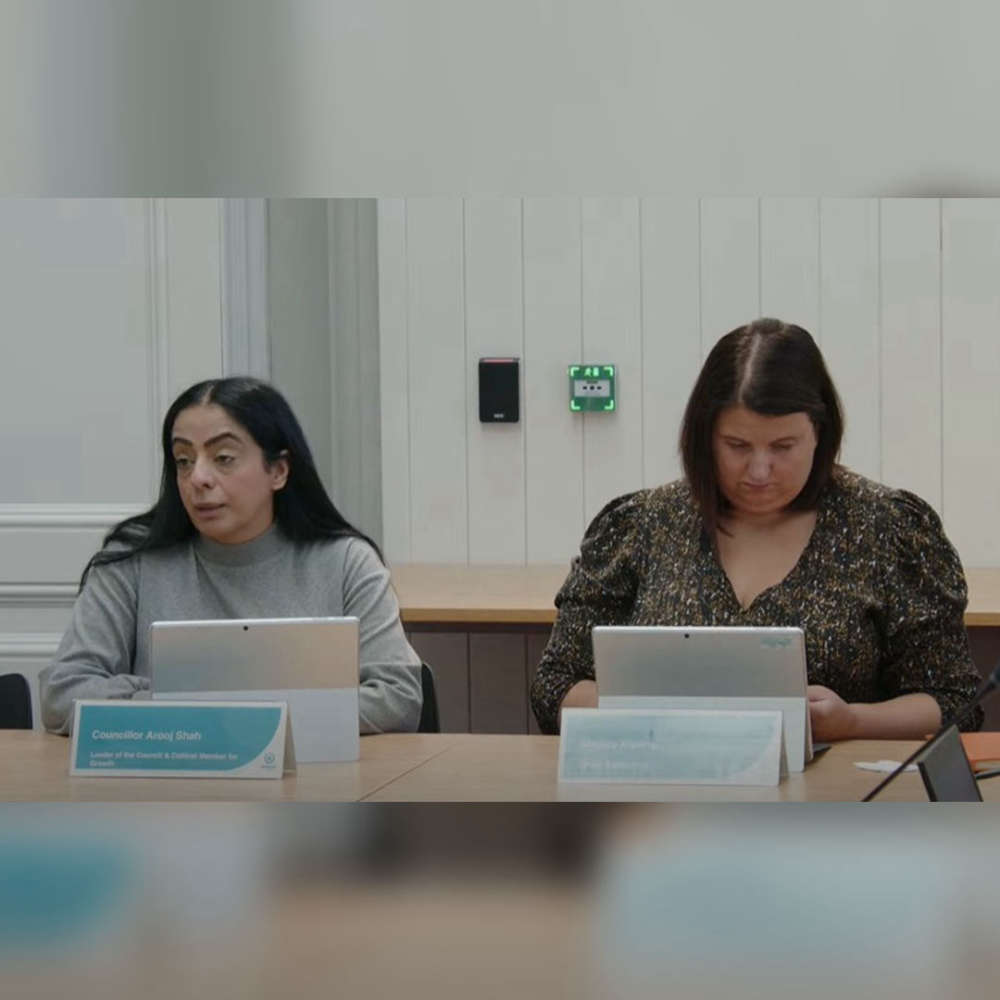
Everyone is screaming. The beige walls of the town hall chambers echo with it. Councillors talk over each other, jabbing accusatory fingers into the air, while residents in the public gallery pick up a sporadic chant of “Traitors! Sell-outs! Scabs!” Welcome to Oldham Council.
This was the scene in November 2024, when an argument in the chambers became so heated the meeting had to be adjourned and riot police – who were on standby for a peaceful protest outside the town hall – were asked inside to ‘have a word’.
Oldham regularly descends into chaos. Inside the town hall, meetings are frequently interrupted, councillors are accused of spying on each other, and elected representatives are exiled to abandoned parts of the building.
Protesters have been dragged out of the chambers. The council leader has had her car firebombed. Bullets carved with councillors’ names have allegedly turned up on their doorsteps.
But Oldham’s ‘toxic politics’ extends far beyond the walls of the Civic Centre. From Elon Musk pointing the global spotlight onto the rainy town in the North West of England, to being name dropped by the Prime Minister on subjects ranging from immigration to historic child sexual exploitation.
“It can’t be like this at other councils, surely,” Lucia Rea, a former councillor between 2022 and 2024 told the MEN. “My stomach used to turn when I sat in that chamber.”
How did it come to this?
For over a year, the LDRS has been investigating Oldham’s toxic politics. How did things get so bad? Where did it all start? And most importantly – what is the solution?
Some point to ‘bad actors’ in the community, others to the borough’s high level of deprivation and segregation. But the truth seems to be rooted much deeper in Oldham’s past, coupled with a perfect storm of a toxic internet culture, populist councillors, and a lack of transparency that has led to accusations of corruption and organised cover-ups.
As part of our work, we interviewed dozens of key figures. One thing was striking.
People keep bursting into tears. In cafes, council offices, on the phone. People on the sharp end of Oldham’s toxic politics have had enough.
“Everybody is depressed,” a councillor tells the MEN. “That’s the atmosphere among members of staff. In terms of the atmosphere between councillors, it’s ridiculous. The level of disrespect and hostility towards people is just indecent.”
And one thing is clear: this isn’t just about quibbling councillors. From the local communities increasingly at odds with each other to the survivors of grooming gangs who have had their horrific experiences exploited for political gain, there is a real human cost to the messy politics happening in Oldham.
The legacy of the riots
“There was smoke, petrol bombs, fires, sirens, people screaming,” Rafit Hussain recalls, the sights and sounds still vivid twenty-five years on. He had been making his way home when he saw some teenagers throwing stones at a car in Glodwick, a predominantly Pakistani area.
The flashpoint had come earlier that evening – Saturday, May 26, 2001 – when a group of Asian teenagers, who were playing cricket near the ‘Good Taste’ chip shop on Roundthorn Road, got into an argument with two white boys. What followed over the next three days would later be described as the ‘worst racially motivated riots in the UK for fifteen years’.
Burning barricades were built in Westwood. The Jolly Carter pub on Lees Road was firebombed, while the windows of the Oldham Chronicle newspaper office in the town centre were smashed. “The noise, the atmosphere, it was something to experience,” Rafit says.
Soon after the riots, John Prescott, who was the deputy Prime Minister at the time, visited Oldham. The story goes that, as he stood in the town hall, councillors from the Liberal Democrat group were in one room with Labour in another. They were not speaking to each other.
“He brought them all into one room and gave them the biggest bollocking you can imagine,” a former council employee says, recalling the story that was widely shared among staff in the noughties.”’How can you fix your town when you don’t even talk to each other?’ he said.”
Nastiness in Oldham’s politics is nothing new. The town’s problems are deep-rooted.
Oldham, which was once the cotton spinning capital of the world, has long been a symbol of deindustrialisation and decline. It regularly ranks among the most deprived places in the country with more than half of the children in some of its neighbourhoods living in poverty.
These issues were undoubtedly exacerbated by the austerity of the 2010s which saw the town lose much-needed public funding. But these economic factors are not unique to Oldham – a similar story is told of other towns and cities across the north of England.
Deprivation alone does not explain the division and distrust. But maybe demographics can.
While the borough is ethnically diverse as a whole, members of each ethnic group tend to live among their own. This is not uncommon, but it has caused problems in the recent past.
The race riots in 2001 proved that it wasn’t just the politicians not getting on. The inquiries that followed spoke of segregated communities living ‘parallel lives’ in towns like Oldham.
These reports – which included the Ritchie and Cantle reports – found that interactions between members of each ethnic group were limited with hardly any mixing happening in schools. “Pakistanis, Bangladeshis and Whites simply do not meet one another to any significant degree,” the Oldham Independent Review led by David Ritchie concluded, “and this has led to ignorance, misunderstanding and fear.”
The Ritchie report lists a number of ‘strongly held beliefs’ which affected community relations in the town, all of which turned out to be untrue. The false claims of ‘no-go areas’, Asians getting jobs because of their colour and ‘excessive demands’ on the NHS’ might sound familiar.
Among them was also an allegation that St George’s flags were removed from lampposts because White people could not celebrate their national day when in fact the council, which flew the flag from the Civic Centre, considered them to be a distraction to road users. The parallels 25 years on are undeniable – the only difference is the way in which lies are spread.
Online Culture
“Gangsters run my town,” says a man perched in front of a camera. “They have infiltrated the highest levels of power.”
This man is Raja Miah, known online as Recusant Nine. He has hundreds of videos and blog posts dating back six years, with titles such as ‘The Bad Smell around Andy Burnham Gets Stronger’; ‘The Hidden Truth behind R*pe Gangs Exposed!’; and ‘Shah, Samosas & the Weaponising of Mango Chutney’.
His recent videos have a professional look to them, with high quality cameras and microphones and a neutral background. Miah has made a business out of this kind of content. Last October, he opened a Companies House account called Recusant Nine Ltd, with Miah listed as sole director. He receives a steady stream of donations through platforms like Buy Me a Coffee, where members of the public can anonymously send contributions starting from £3.
In less than a week after announcing his intention to ‘sue’ the local MP Jim McMahon over ‘false allegations’ on X, he raised more than £50,000.
According to data shared by Miah, his viewing figures hit more than a million last year. On Facebook, his posts have been viewed more than 28m times, he claimed.
Miah describes himself as an activist working to ‘end political corruption in his hometown’ and raise awareness about ‘historical injustices endured by working-class communities’. His roots are in charity work – he was involved in community cohesion projects carried out following the 2001 riots in Oldham and Rochdale, for which he received an MBE in 2004.
After the charity he worked for, Peacemakers Oldham, folded in 2013 when some of its government funding was cut, Miah then set up the Collective Spirit Free School, which was later forced to close after a damning Ofsted report found the school ‘inadequate’ in all areas, with educational failures, poor leadership and ‘inedible’ school meals.
From then, the tone and nature of Miah’s campaigning appeared to shift.
More recently, his social media has peddled extreme narratives, painting Oldham politics as ‘a turf war between two Pakistani cartels’, that ‘Pakistanis rig the borough’s elections’, and accusing GMCA, GMP, Oldham Council, and the media of being part of a colluding ‘rape gang cover-up team’.
His new stated aim is to ‘expose how politicians protected the rape gangs’. It’s true to an extent that he has played a role in raising historic child sexual exploitation in Oldham onto the national political agenda. But he’s also been accused of making a business out of fanning the flames of the long-standing division and segregation between white working class and Pakistani communities in Oldham.
In 2021, local MP Jim McMahon tried to describe the spiral of Oldham’s increasingly toxic politics in a series of blog posts, where he claimed Raja Miah had participated in an ‘unrelenting campaign’ to share ‘interconnected false narratives’. Mr McMahon summed these up as follows: “The first, claiming that Asian grooming gangs are operating with the protection of Labour politicians in return for votes. Secondly, that there is organised and widespread postal vote fraud. Thirdly that there is widespread corruption linked to politics in Oldham run through ‘cartels’. …
“[It] is clear that this is intended to further deepen division and cement the false narrative that your local MPs only work for the Muslim/Asian community at the expense of the White British community.”
A former senior member of the council described Raja Miah as ‘creating a bandwagon’ for the ‘perfect storm of a working class town with a lot of deprivation and segregation’.
Miah’s posts often begin from public events or official sources – photos of councillors, phrases from government reports – and use these as an occasion to opine on perceived stark divisions between white working class and Pakistani Muslim communities, and create “us versus them” narratives.
In one post, he shared images of Pakistani-heritage councillors, and another of the council leader meeting visiting politicians from Pakistan, claiming the images ‘should disturb anyone who cares about democracy in Britain’.
“I believe it exposes a foreign-aligned network operating inside a British town,” he said. “British democratic norms are being overridden by Pakistani tribal politics operating under the cover of council meetings. The consequences are devastating. White residents get barred from these coordination sessions. Other minorities are shut out of clan decision-making. When your local council answers to Pakistani kinship elders rather than British voters, democracy becomes an illusion.”
In another, he says: “They called us far right extremists when we exposed the rape gangs. They demonised us as racists when we spoke out against the growing Islamist threat in this country and the creeping of Sharia law into public life. And they called us conspiracy theorists when we exposed how the Pakistani biraderi exploit weaknesses in our democracy to manipulate elections.
“On every single occasion, we have been proven right. On every occasion, they have tried and failed to silence us.”
His content is frequently reposted in far-right and anti-Muslim groups online.
Miah rejects the characterisation of his work as divisive, pointing to his former charity work on community cohesion.
“The big problem is social media,” said Samantha Walker-Roberts, one of the Oldham survivors who has bravely waived her right to anonymity.
“People like Raja Miah who aren’t involved in this at all, yet he’s the one who’s feeding this specific narrative, which is then firing up all these far rights.
“And this is why society is collapsing. It becomes less about what we went through, and more about racial issues.”
When Sam was 12 years old, she courageously made her way to Oldham’s police station to report that something horrific had happened to her. A week earlier, she had been sexually assaulted by an older man in a graveyard.
Police dismissed her report. And upon leaving the station, she was abducted by two men and taken to a quiet semi-detached home. There, for hours, five men took turns to rape and abuse her.
A GMP Spokesperson said: “Samantha suffered horrific abuse which was compounded by appalling failures by the authorities that should’ve protected her at that time. This is why the Chief Constable personally apologised to her when the Oldham review was published in 2022.
“The way Samantha was treated by police was far from the standard survivors can expect from the GMP of today. Her case was reviewed in 2023 and we have asked the national Hydrant team to further review this case independently to ensure all available avenues to justice continue to be explored.”
One man has been convicted for abusing Samantha, a search is ongoing to locate a further suspect, and identify a third.
Sam has told her story in her own words in parliament, in her book ‘Undefeated’, and in several media interviews. That still hasn’t stopped it being co-opted by agitators on social media – and sitting councillors in the chambers – for their own political agendas, she says.
In the last eight years, Miah has amassed an increasing influence on right-wing communities – and later on the local council, by helping certain councillors gain their positions in elections by endorsing them online and giving them campaign advice. More recently, he’s started backing the local Reform group, calling for his audience to vote for them at the local election, and turning up in support of them and in particular their local leader, coun Lewis Quigg, at the local election count on May 7.
Some survivors of CSE have accused Raja Miah of ‘using their stories for his own agenda’ – an allegation he has publicly denied.
But it’s also the councillors, Sam said, and later national politicians, who she argues have a lot to answer for, after using her and other people’s stories as a ‘political football’ for their own benefit.
Miah turned down the opportunity to answer a series of standardised questions put to all interviewees as part of this investigation in October last year.
More recently, when given a right of reply to the above, Miah said ‘each allegation is false’ and denied his content was divisive, stating he was an ‘anti-racist campaigner’. He also denied that his content had incited any action or harassment against local figures.
He added: “You should understand what you are dealing with. I am a man from Oldham who watched this town’s children be raped while its institutions looked away. I stood up when doing so cost me everything. I stood up when no one in mainstream media would touch these stories. I stood up when the political class closed ranks against me. I am still standing.
“I have been arrested. I have been charged. I have been blacklisted, de-platformed, and subjected to sustained harassment by people who believed that sufficient pressure, applied consistently enough, would eventually produce my silence. It did not. Every attempt to stop this work has failed. This attempt will fail too.”
The story of allegations of shisha bars in Oldham being used for grooming and sexual exploitation came to light in January 2014 – five years before Miah started his campaign. The BBC followed suit a month later, and MP Jim McMahon, then leader of the council, responding a few months later in a blog post. In it, he suggests that ‘shying away from accepting that in Rotherham, Oxford, Rochdale and here in Oldham, this particular form of abuse is predominantly Pakistani men targeting white girls, is not helping the victims, and nor is it helping the Asian community at large’.
He goes on to specify that these behaviours ‘exist within communities and institutions’, in the same way it has happened in parts of the Catholic Church – i.e. not generalised cultural norms, as they are presented elsewhere.
Recusant Nine is not the only social media account who amplifies and transmits skewed narratives about the town. Today, dozens of prominent internet figures populate community groups in an increasingly toxic and powerful internet culture across the borough.
And because of the way the algorithms work – privileging divisive content because it evokes likes and reactions – these platforms have helped harden up existing tensions between communities in Oldham. The town is more segregated than ever, according to local community champions and charity organisations, with some describing the atmosphere as ‘like before the 2001 riots’.
What happens when communities who don’t speak to each other read horrific tales about each other online? It breeds more distrust, more outrage.
This isn’t unique to Oldham, of course. But with its explosive history and demographic split, the line between what happens online and what actually happens in the borough was already much thinner than in many other places.
And eventually, it encouraged people to ‘take matters into their own hands’ to mete out perceived justice or revenge. It has motivated protestors wielding ‘Cover Up’ posters to disrupt town hall meetings, mobs to show up outside council leaders’ homes, and councillors supported by online agitators to spark ferocious debates in the chambers.
Failures that never went away
Kayla was 14 when she started being groomed for sex with older men. Two individuals plied the vulnerable teenager with drugs and alcohol before delivering her into the arms of depraved men more than three times her age. It happened almost every night – for two years.
“I once tried to count the total number,” said Kayla, whose name has been changed to protect her anonymity. “I spent a long time in hospital after that. It broke me all over again.”
Kayla had social workers, who she believes failed to intervene at the time.
“In my social work files, they’d write of that time that I had ‘sought out criminals’ and ‘put myself in vulnerable situations’,” she said. “As if I wasn’t a teenager, a child, anything.”
Yet Kayla wasn’t included in Oldham’s first review into child sexual exploitation. In fact, she didn’t know anything about it until she checked into a women’s refuge the year it was published, and a staff member directed her to the results.
The Independent Review into Historic Child Sexual Exploitation was launched in 2019 to analyse how the local authority and police had dealt with historic child grooming cases – and to investigate claims that were being made online that they were ‘part of a massive cover up’.
These were claims amplified by Raja Miah; as well as a small group of vociferous community members who hounded the then council leader Sean Fielding. The group’s tactics included screaming abuse at Fielding from slow-moving cars when he was out for runs in his local Failsworth, turning up outside his house with small, angry mobs during the Covid-19 pandemic, and inciting abusive pile-ons on Facebook.
The report’s 199-page conclusion outlined a list of shocking failures by council services and Greater Manchester Police to intervene in cases of alleged child grooming.
It also found there was ‘no evidence of a deliberate cover-up’ by members of the council.
Despite the damning results, many people had already lost faith in the review before it was published in 2022 – following a number of delays.
Political groups, independent councillors, social media activists and a GMP whistleblower took aim at the review’s ‘narrow terms of reference’, suggesting that cases had been ‘cherry picked’ and documents ‘disappeared’ to underplay the extent of the problem.
The terms of reference were specific. They looked at a core period of 2011 to 2014, concentrating on shisha bars, taxi drivers, children’s homes, and the cases of known offenders previously employed within Oldham Council.
It is now widely agreed that the review was ‘fundamentally flawed’. Several sources involved in the review told the LDRS that the terms of reference for the Oldham inquiry were set ‘on the basis of what was being said on social media at the time’.
The hope was that an independent review addressing the allegations being made about the council’s handling of grooming gangs would put the issue to bed. How wrong they were.
Not only was the review limited in scope – looking at specific, often unrelated allegations rather than considering the issue as a whole and speaking to survivors about their experiences – getting access to the information required was an issue. Malcolm Newsam and Gary Ridgway, who led the review, were told time and time again by police and council officials across Greater Manchester that they could not have the information they asked for, either because it was ‘difficult to find’ or due to ‘data protection’, the LDRS understands.
When the information did eventually arrive it was redacted and the review team were left ‘exasperated’. Eventually, however, after ‘lawyering up’, the reluctant officials relented.
A GMP Spokesperson said: “The Chief has previously expressed how current legislation has been a barrier to information sharing during previous inquiries and investigations, as was highlighted in the Casey review last year. This is something we hope the introduction of the duty of candour and the forthcoming national inquiry will address as part of its scope.”
Still, the review faced multiple delays, with its publication postponed several times. This was partly because a survivor, who appears in the final report as Sophie, came forward and, after having initially been instructed not to contact her, the review team decided to speak to her.
The review team was also forced to remove anonymised details of specific cases from the report a week before it was due to be published after police informed the survivors involved. Rather than including details of these cases, all that remained in the report was a summary.
Reflecting on the review, Mr Newsam told the LDRS that he did not believe it was ‘fair’ to say the review was fundamentally flawed from the start, as others have said. The terms of reference, as set out by the Council, were targeted at addressing the specific allegations that were circulating on social media at that time. The subsequent report dealt with those allegations forensically. The review was never set up to be a wholescale review of the prevalence of CSE and grooming gangs and never could have been given the limited access the review team had to information held by GMP.
However, he says that as the review progressed it became clear that the outcome would never satisfy some people. “As we get further and further along writing our review, you realise there is no way you’re going to satisfy those people who believed there had been an institutional cover up at the highest level, even though a diligent review had not found any evidence of that. So of course, even though our review exposed and was highly critical of much of the poor practice and failures we found, as soon as our review was published, a significant contingent called for a full scale public inquiry.”
And the issue remains a vexed one. Sam, a survivor who was very critical of the assurance review as it came out, now reflects positively on the report.
“I fell for all the stuff that was written online,” she said. “It took me a year to get out of that bubble and realise it’s actually helped me get to where I am today. They expanded the terms of the report to include my case even though it fell outside the time period. Ultimately, it identified a lot of failures and exposed that GMP were putting in restrictions. Though, it does feel like there’s still stuff that’s hidden from us.”
For Sam, the issue was how the council treated survivors throughout the process and in its aftermath, with piecemeal communication and little psychological support.
But other survivors maintain that the assurance review fell short of their expectations, and the only way to get to the truth was through a government-backed investigation.
Former council leader, Sean Fielding, who first asked Greater Manchester mayor Andy Burnham to include Oldham in a regional review of child sexual exploitation, admitted to the LDRS: “I still don’t know if it was the right thing to do. What is blatantly clear is that there were serious failings on behalf of the police and other public services that needed to have a light shone on them. The problem with it is that the noisiest people on this will never be satisfied because for them, it’s not about getting justice for victims, it’s about getting back at people they don’t like.”
The Government Review
Even before the review concluded, there were calls for a new one. Opposition councillors of all political stripes called for a government-led inquiry six times at full council meetings.
The Labour majority voted the suggestion down five times, or voted through amendments that watered down the request to government.
These meetings were frequently fiery. Protestors attended the public gallery, banging on plastic partitions put up as part of Covid-19 measures, heckling councillors, and holding up signs reading ‘Cover Up’ and ‘How many children’. Anger in part of the community was continuing to spread and remaining trust in the local authority was failing fast.
In 2024, after Labour lost overall control of Oldham council at the local elections, a deal was struck. Council leader Arooj Shah agreed to back calls to the government for a new inquiry in a bid to gain support from independent councillors and keep Labour in power.
What followed was an extraordinary intervention by the world’s richest man Elon Musk who branded safeguarding minister Jess Phillips, who rejected the request from Oldham council, a ‘rape genocide apologist’. Suddenly, demands were being made for a full national inquiry looking at the issue of grooming gangs in towns and cities across the UK.
At first, the government stuck with its stance. There would be no government-led inquiry, national or otherwise, but there would be money available for local reviews to be set up.
Then, six months later, a U-turn was announced after a ‘rapid national audit’ by Baroness Louise Casey concluded that a national inquiry was needed.
After encountering major setbacks earlier in 2025, the government finally settled on a chair for the inquiry and is making inroads on the process. As if to answer what Mr Newsam told us, internet activist Raja Miah immediately denounced the inquiry he’d spent six years campaigning for.
In a video taking aim at Andy Burnham, Miah said: “The national inquiry is not the ending. We knew this was going to happen.
“You saw me on the steps of Rochdale town hall before any of this came out to confirm that the national inquiry will be a cover-up. The National Inquiry is not our ending. It is our beginning. Burnham should be afraid.”
Impact on public servants and politicians
Politicians in Oldham are already afraid.
Throughout the period before and during the assurance review, politics in the borough started to go increasingly haywire.
“I didn’t take much notice and was quite dismissive when [the online noise] started affecting my social media,” former leader Sean Fielding reflected on the period before the local review was called. “The people who were involved in Failsworth were known thugs and racists. I sort of just thought – this is just part of living in a North Western town.”
But then a resident turned up to a meeting in November 2019 and started heckling councillors so aggressively the meeting was suspended twice. Soon, verbal abuse hurled from the public gallery became a common soundtrack to the council processes.
And it wasn’t just inside the council chambers.
Councillors started experiencing aggressive verbal abuse on the streets where they lived and receiving regular death threats.
One former senior member told us: “It was terrible. My house ended up being double alarmed. We had CCTV. People would say they followed me home, they would pour acid on me. The police would accompany me home after full council.
“I slept with a fire blanket. You shouldn’t have to live like that.”
Voice messages heard by the LDRS, left by strangers on outgoing council leader Arooj Shah’s answering machine, show the extent of violent and racist abuse local leaders are subjected to.
One caller is recorded saying: “You f******g Pakistani b****. F*** you. I hope the English men start raping your Pakistani daughters […]. You filthy Pakistani Muslim race. I’ll come and f*** your mother and your daughters and say ‘it’s not about race’. All Muslims must be f***** and hanged.”
Coun Shah is also currently waiting for a court hearing of a man who allegedly verbally abused and threatened her at a petrol station, in full public view. The man has pleaded ‘not guilty’ after being charged with a public order offence.
Ever since her car was firebombed outside her home, she parks in a special CCTV-covered bay, and lives looking over her shoulder.
“This abuse just heightens and heightens,” she said. “It’s been normalised. You won’t see me in a supermarket now. I do everything online – it goes against everything I believe in. You won’t see me in a park unless I’m in my role – I don’t feel safe in those spaces anymore.”
Of the £31.8m spent on refurbishing the Old Library – now the J R Clynes Building – into the new town hall, £2.1m was spent on security and privacy features such as bomb-proof doors, soundproofing, panic buttons, and an extensive and elaborate keycard system that means members of the public and press must be accompanied by a member of staff at all times.
The abuse happens at all levels. MP Jim McMahon told the LDRS: “We’ve had people convicted of making death threats. Those felt like real death threats – people saying they were going to come to my house and put me against a wall and shoot me. I’ve had people circulate pictures of my house on X with ‘we know where you live’ messages. We’ve had people attempt to breach the office to make threats, placing my staff at risk. You start living your life looking over your shoulder.”
Meanwhile Public servants are ‘scared to wear their lanyards outside the town hall’, according to senior sources at the council. The local authority struggles to attract and retain talented officers because of the treatment of staff by both members of the public and some elected officials. That has an impact on the quality of services delivered by the council too – directly impacting residents.
And while this behaviour started online and among members of the public, things have started to shift in recent years.
Political alliances
The motion for a government review in CSE ultimately passed not because of a change of heart, but because of political necessity.
On May 2, 2024, Oldham Labour lost their overall majority.
Predominantly white working class areas of the town disillusioned with the handling of CSE among other key issues voted for independents. And much of the Asian heritage community, angered by Sir Keir Starmer’s lack of response to the conflict in Gaza, threw their support behind the Oldham Group, a pro-Palestinian Muslim interest group spearheaded by former Tory councillor Kamran Ghafoor.
Opposition groups started banding together in a fevered attempt to ‘overthrow’ the Labour council leader and replace the administration with a ‘rainbow alliance’ of political groups and independents.
Oldham Labour – still the biggest group in the council with 27 members – desperately sought out a coalition that would keep them in power. The partnership came from an unlikely extremity of the political spectrum: some of the independents who had most fervently campaigned on CSE, many of whom first became involved in politics with Raja Miah’s help, but had since distanced themselves from him.
It was a strange turn of events that saw the Labour group allying themselves with a councillor who once shared pictures of himself dressed in a Nazi-inspired uniform, and others who had spent the last two years aggressively opposing them in the council chambers.
And it came with strings attached.
Independent councillor Marc Hince said: “We made the working agreement because we knew there was no other way Labour would ever agree to the government inquiry on CSE, tighter rules on HMOs, and funding for areas like Shaw. Whatever people say, we got things done.”
The deal was instantly controversial. A case of council espionage resulted in parts of the negotiation meeting being leaked and released online without context. There followed a torrent of online abuse for the councillors involved, who later described receiving death and rape threats, and abuse that included graphic descriptions of desecrating one councillor’s mother’s grave.
Liberal Democrat coun Mark Kenyon, who was caught on CCTV placing a ‘listening device’ outside the council leader’s door had to withdraw his candidacy as MP for the 2024 General Election.
All non-Labour political groups were jettisoned from the councillors’ rooms at the old Civic Centre, and banished to an abandoned upstairs corridor. To hammer home the uncanny atmosphere in this semi-deserted corner of the Civic Tower block, which was slowly being vacated for the council’s new offices at the Spindles shopping centre, someone taped a sign to the entrance that read ‘Welcome to the Twilight Zone’.
Something broke at the council. Any vestige of collegiality completely disappeared, according to several sources.
While councillors liked to grandstand and put on a show in the chambers before, away from the public eye the majority of elected officials ‘got along’ even across political divides.
“That stopped,” one councillor shared. “The agreement was not to be an a******* to each other outside of the chambers. Suddenly, the animosity just wouldn’t end.”
And senior officers at the council described how it became ‘impossible to have reasonable conversations’ and that people ‘acted in ways that would have been unthinkable just a few years ago’.
It has reportedly slowed things down at the council. More decisions are being delegated to senior officers, putting processes behind closed doors.
Breakdown of trust
What started as small, combative groups who turned up to disrupt council meetings has now disseminated across the general public in Oldham. Speak to a handful of pedestrians in the town centre or Alexandra Park, and you’ll quickly find people who are convinced the council is ‘rotten to the core’.
These beliefs are often intertwined with racist and islamophobic prejudices against people of Pakistani heritage. But they’re increasingly uttered by all creeds, with groups like The Oldham Group making use of the ‘corruption’ tropes, while positioning themselves as an interest group representing the predominantly Asian-heritage populations in Oldham’s central wards.
There are aspects of Oldham’s politics that don’t help with these rumours. Coun Shah’s close relationship with Dale Creghan’s former getaway driver, ‘Irish Imy’, has long been a source of speculation. The departing council leader has been pictured on personal social media pages with Irish Imy, who was convicted for providing a getaway vehicle and hideout for cop-killer Dale Creghan after an attempted murder on a rival gang family.
Coun Shah has previously acknowledged that some of her relationships would be ‘difficult for some people to accept’, but that she ‘can’t pretend they don’t exist, and certainly I can’t turn my back on people I’ve known since childhood’.
Secret letters sent to the government to undermine a democratic vote; a perceived lack of transparency around deals such as the Eton Star Academy; and a reluctance to be open about unforeseen delays and extra expenses on major regeneration projects. Most of these aren’t so much signs of corruption – though some take them as evidence of such – as a lack of communication and a showcase of the stretched capacities as the local authority struggles to recruit or maintain high-quality staff.
These mistakes are fed into a wider narrative that has led different groups to turn away from the existing Labour administration and towards an increasingly sectarian politics. Some Muslim and Asian heritage groups feel Labour has particularly failed in relation to the national stance on Palestine, and have turned to the Oldham Group. Meanwhile white working class areas have turned to Reform.
Others have turned away from the borough’s politics entirely.
“I don’t trust any of them,” one Alexandra resident told the LDRS just before the local election on May 7. He asked not to be named, out of fear he’d ‘get his windows smashed in, or his car set on fire’. His perception of the council’s politics was so poor, he intended to spoil his ballot in protest.
Meanwhile Mohammed, from Glodwick, said there was ‘so much fighting’ at the council, he wasn’t sure he’d bother to vote.
“People are dragging up people’s dirty laundry from the past and sharing it around families, it’s really dirty politics,” he said.
And as a final example, Roy Willans, 66, a Reform supporter, expressed a perspective carried by a growing percentage of particularly white working class Oldhamers.
Willans said: “I just don’t understand why we’re spending all this money on housing [immigrants] – and then you see them trying to close down services like Chadderton Hall Park [adult day care centre], or people who can’t afford their own care. The money is really tight.”
When resources are as limited as they are at local authorities, it always looks like the other side is getting a better deal.
This fracturing politics in Oldham has come to a head in the latest local election.
This year’s campaign period was fraught with conflict. Councillors lambasted other councillors in front of diggers or satirical print-outs of their faces on TikTok. There were reports of activists clashing in the streets, racial abuse hurled on doorsteps, and suggestions some candidates were ‘only talking to white families’ and others ‘only to Pakistani families’.
The result was a ‘devastating’ defeat for Labour and an almost clean sweep of victories for Reform UK, alongside smaller wins for the Oldham Group. Labour boss coun Shah has agreed to step down from her leadership position at the council.
But after a five-hour long council meeting on May 20, the council remains in stalemate.
In a borough where politics is broken, it seems no one wants to lead anymore.
The Search for Hope
Trust has broken down in Oldham – among politicians, of institutions and between different communities. And over the years, attempts have been made to find solutions to these problems.
In the aftermath of the Oldham riots, efforts were made to bring people from different ethnic backgrounds together, particularly in schools. New Labour’s Building Schools for the Future programme was used as an opportunity to merge so-called segregated schools, in which the majority of students belonged to one ethnic group, to encourage mixing from a young age.
Three mixed schools were born out of the programme – and while some have struggled academically, there were positive signs that the plan was beginning to work. In 2017, a study found ‘higher levels of trust’ at these schools where pupils expressed ‘more positive attitudes’ about their peers from different ethnic groups than in more segregated schools.
But according to one source who was involved in the programme, changes in political leadership at the town hall meant that initiatives like this were no longer a priority. Instead, local politicians became ‘more and more inward looking’ and ‘consumed’ by other things.
Leaders past and present have denied this, pointing to a lengthy list of projects aimed at addressing community cohesion. But there’s no denying their efforts have been hampered.
After 2001, public money poured into Oldham. The extension of the Metrolink is one major example for which the riots were cited as evidence the town desperately needed investment.
But over the last 15 years, public money has been taken out of the town. Cuts to local government since 2010, mean that councils like Oldham have had less money to spend, not only on initiatives aimed at addressing community cohesion, but on all of its local services.
Since then, the town – which now has some of the highest levels of child poverty across the country – has suffered. Recent data from the Social Mobility Commission suggests that the borough now ranks amongst the worst places to grow up in the country with ‘conditions of childhood’ described as ‘unfavorable’. And while the Labour market opportunities for young people did improve between 2012 and 2017, this measure has since dropped back down to ‘lower middling’.
And as resources have become more stretched, tensions over where in the borough, and to whom, the remaining resources are allocated have been heightened.
“In 2001, when we had the riots, it was a small issue that blew out of proportion, but it became about them and us. That’s what happens,” coun Shah said.
“Everyone thinks they’re left behind but what they don’t understand is that nobody’s been left behind. If one community gets something, the other community feels they’re not getting anything.
“But the reality is, none of you are really getting what you deserve.”
It’s clear that this belief has underpinned much of the Labour administration’s strategy in the last ten years, with major regeneration projects aimed at bolstering the overall economy.
Harsh economic conditions have undoubtedly made it harder for the town hall to deliver on some of those promises to the public. Failed projects, such as the ill-fated plan to bring M&S to the town, damage trust in the council, creating a ‘I’ll believe it when I see it’ attitude among residents.
Yet a number of major projects have now been completed in the town – a new foodhall, market, and a refurbished town hall – as well as several that are in the pipeline. But are these new developments – that critics slam as ‘vanity projects’ – enough to solve decades of festering division and a stagnating economy?
In a recent interview following Labour’s ‘devastating’ election results, coun Shah said: “Everything our administration has tried to do was about uniting people, showing what our common good is by creating economic opportunities. The thing about community cohesion and economic delivery is they’re inseparable – if you get the economics right, it helps cohesion. We tried our very, very best.
“I was hoping people would understand the vision we had for Oldham. But the reality is we couldn’t beat the narratives of division.”
Some lessons have certainly been learnt over the last 25 years. In the summer of 2024, when the Southport riots spread across the country, trouble in Oldham seemed inevitable.
Coun Shah recalls journalists, including from international outlets, camped in the town, expecting a repeat of 2001. But while some protesters turned up, events passed peacefully.
The council puts this down to its work identifying the voices that communities listen to, rather than relying on the ‘traditional go-to’ representatives. Those voices helped avert violence.
“I think the way we approached community cohesion post-riots has to be different in today’s context,” Mr McMahon says. “First of all, people’s social networks and where they get information from is far more complex than it ever was before and I’m not sure that governments, whether they’re national or local, fully understand the implications of that.
“The other thing is that, traditionally, councils, because it would be easier to map out where these groups were, would generally go for organised groups, whether they’re community groups or mosques or church networks, as their conduits for community relations and I don’t think that applies anymore.
“I do think the council and national government need to think differently about how we are building a sense of a collective identity, a collective purpose and how we’re communicating with different neighbourhoods, different audiences, because they are not the same groups as they were 20 years ago.”
So what makes Oldham stand out from the crowd? A place where politics is so toxic that the council leader requires Home Office security and councillors are engaging in espionage.
Deindustrialisation, decline and deprivation has affected towns and cities across the North of England, as has austerity. Some point to the town’s segregated communities as the source of distrust – but Oldham is not the only place where each ethnic group lives among their own.
Others will point to the town’s recent history of grooming gangs and failures to tackle them. But Oldham is far from the only place with a shameful record on child sexual exploitation.
Perhaps it is these ‘bad actors’ taking advantage of this perfect storm to stoke division and hatred.
Or perhaps Oldham isn’t different at all. Perhaps it is simply the canary in the coal mine.
“I do think there’s something where it happens in Oldham first because of all the issues that we know,” Mr McMahon says. “But you can see the number of councils now who are in turmoil where people are voting for what would have been fringe parties are in control of councils.”
“I actually think Oldham has just been five years ahead of where everywhere else has been,” one former senior member of the council echoed. “This is the future of local government everywhere, if we don’t do something.”
Solutions
And is there a solution to Oldham’s problems?
“I can’t see an end to it right now,” one sitting councillor told the LDRS: “This is going to carry on getting worse before it gets better. Despite everything, I don’t think we’ve hit the low point yet.”
Former senior members of the council shared that sentiment. It’s not possible to socially engineer a solution to Oldham’s problems – the only way forward would be for the council to ‘hit rock bottom’, they said.
And residents of the borough told the LDRS they thought it was simply ‘too late’, and that interventions should have been made 15 years ago.
But what does that look like? And where does that leave the people of Oldham?
The borough is currently locked in a stalemate in regards to its leadership. The Labour group have bowed out of their administration after Reform’s sweeping victory, but the Reform group refuses to form a coalition with any other group – and don’t have enough members to gain the amount of votes required to take over the council.
Whoever ultimately takes the reins will have their work cut out for them. No group has even a third of the council’s membership, meaning motions will need a cross-party consensus to pass through the town hall.
It could be an opportunity for councillors to sit down, hash things out, and rebuild working relationships that ultimately allow a wider range of communities to feel their needs and wants are being addressed.
Or it could be a complete disaster, where nothing passes at the town hall and the council is effectively run by unelected officers for a year.
Requests have already been made to the Local Government Association, an independent body that supports local authorities, to intervene in negotiations. And some sources at Oldham Council fear government intervention might need to be brought in as a ‘last resort’ to form an administration.
What is clear from the results of the May 7 election is that people in Oldham want change.
But change can’t take place in a town hall where councillors are too busy firing shots at each other to sit down and find a compromise, where public servants are scared to go to their local supermarket, and even senior members seem to have privately given up on things in the borough ever getting better.
There’s no clear single solution for Oldham. The answer would probably involve some combination of the resurrection of the promising cohesion projects that have fallen by the wayside, a clear strategic vision and more opportunities for people across the borough, better funding for the local authority, a functional asylum process at a national level, and better regulation of international social media conglomerates.
But perhaps what Oldham could do with most of all – is a little bit of hope.
 New plans could be decided in Oldham this week
 Police warn residents over car-breaking thieves
 Judicial Review approved for tenants facing 40pc rent increase
 Police appeal for help in locating missing Michael