

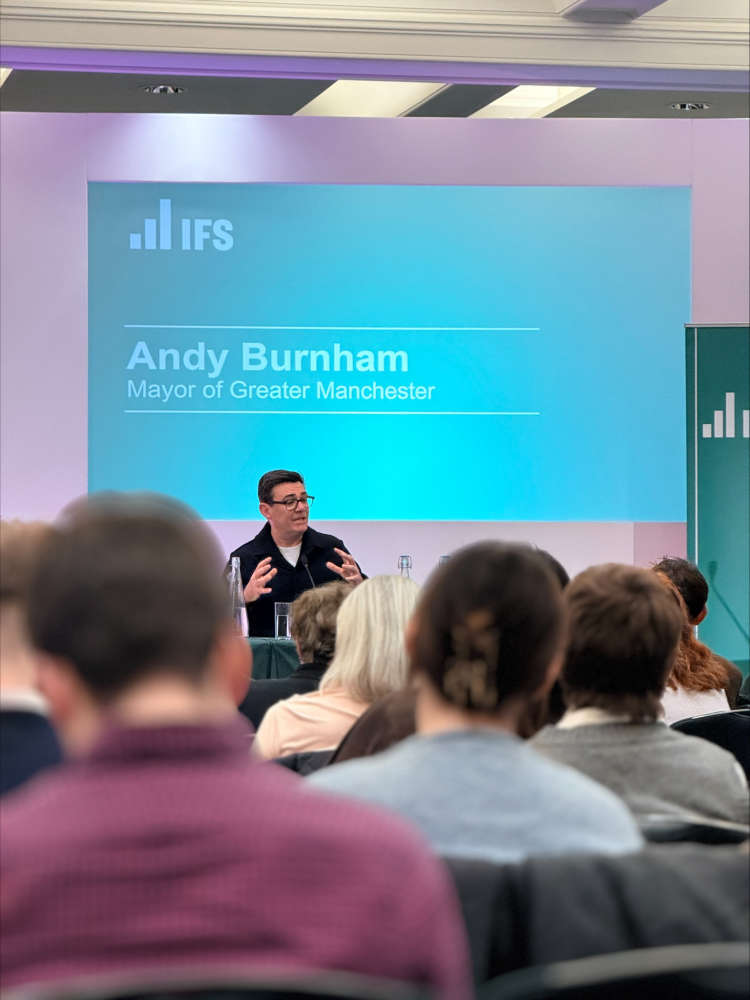
Andy Burnham has unveiled massive plans to ‘reindustrialise the birthplace of the industrial revolution’.
Focusing on five Greater Manchester areas, each tied to specific sectors, the mayor said residents ‘have seen the change in the city centre — but until now they have not had a clear sense on the jobs coming in the boroughs around it’.
“Today we can give them clarity on those prospects,” he added in a speech on Tuesday (January 20) at the Institute for Fiscal Studies in London. “We have built a new politics and are now building a new economy.”
His ‘Manchesterism’ plan singles out five ‘growth clusters’ in Greater Manchester. Each cluster will be dedicated to developing a specific industry to take the city’s economy well past the £100bn mark.
Manchester city centre is home to the ‘digital, cyber, and AI’ cluster, with the ‘life sciences’ cluster centered around Oxford Road’s universities, hospitals, and Manchester Science Park. MediaCity will be home to the ‘creative and media industries’.
The ‘two emerging’ clusters include a ‘low carbon’ area around Carrington, Trafford, and ‘advanced manufacturing’ in Atom Valley, spread over Bury, Oldham, and Rochdale. Leaders have placed massive confidence in the cluster model, believing it will deliver thousands of homes, tens of thousands of jobs, and an economic boost worth billions.
The mayor insists the model is ‘not pie in the sky’ because ‘all five clusters are built or are being built’. The digital cluster in the city centre already has extensive office space, with more being built, and the life science area is well-established with ‘global asset’ UK Biobank opening this year.
Leaders will ‘work with [MediaCity owner] Landsec to double it in size’ to grow the creative sector, Mr Burnham added. However, he admitted construction has only just started on building Atom Valley, where 15,000 advanced manufacturing jobs will be based, and on Carrington’s ‘liquid air energy storage plant’, the centre of 60,000 roles in the low carbon zone.
The ex-Leigh MP said Manchesterism’s planned economic growth is only possible due to ‘a political culture that’s the polar opposite of Westminster’.
He added past top-down, Westminster-dictated approaches to reducing the north-south divide ‘all combined to leave the country in a low growth doom-loop’.
“Our adversarial politics means it’s stuck and we are in hock to the bond markets.
“Manchesterism is a modern and functional response to the 1980s drive to over-centralise power in the Treasury.”
 £2.3 million upgrade makes FCHO homes warmer and energy efficient
 Latics 1 – 0 Grimsby Town: Clinical Latics sink Mariners
 Seventh and final dog recovered after dog walker's van taken in theft in Oldham
 Dr Kershaw’s’ “lifeline” Hospice at Home service celebrates 10 years of compassionate care