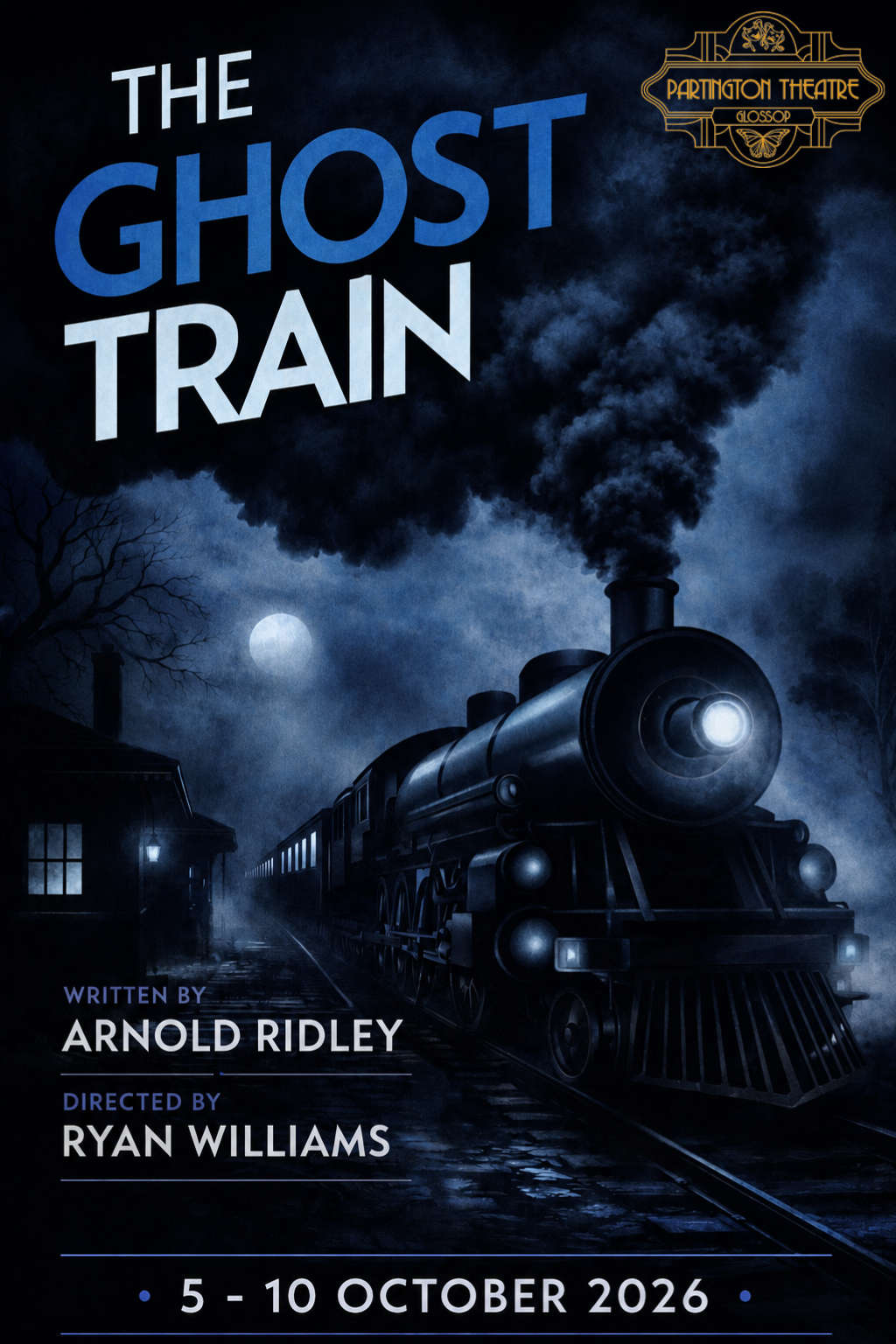

Arnold Ridley’s Ghost Train still has the power to spook
By Philip Williams
It is probably fair to say that Arnold Ridley is better known for avoiding the enemy than for confronting the supernatural. For generations of television viewers, Ridley was Private Godfrey, the mild-mannered, pacifist soldier in Dad’s Army. But long before he joined Captain Mainwaring’s platoon, Ridley wrote The Ghost Train, a hugely successful comedy-thriller in which a mysterious train hurtles through the darkness and apparently brings death with it.
Now the play is coming to the stage again, with the Partington Players bringing Ridley’s 1925 work to the Partington Theatre from October 5 to 10, directed by Ryan Williams.
There is a strong local connection, too. Glossop and the surrounding High Peak have been shaped by the railway. The arrival of the line transformed connections with Manchester and Sheffield, while Dinting Viaduct and the Woodhead route became familiar features of the local landscape, and the area’s railway history has its share of strange and memorable stories.
Take the old Waterside Branch, which left the main Manchester to Sheffield line near Dinting and ran through Gamesley and Brookfield towards the mills at Waterside. It was a freight line, normally carrying goods rather than passengers.
But in May 1959, local people got a surprise. A passenger train came slowly trundling along the branch, with children cheering as it crossed the hand-operated level crossings and curious residents coming out to watch. The special excursion had been organised by railway enthusiasts and was believed to be the first passenger train to travel the line for more than 40 years. Even the branch’s long-serving guard could not remember another such occasion.
Ridley’s inspiration was itself rooted in railway reality. He was once stranded overnight at Mangotsfield railway station near Bristol, and in the darkness heard an express thunder past without being able to see it. The experience stayed with him and eventually became the germ of The Ghost Train.
Stranded
The play puts a group of stranded travellers in a remote station waiting room, warned of a mysterious train said to pass through the station at night, and told that anyone who sees it will meet a terrible fate.
For Williams, the play has a personal connection too. He first encountered the story through the famous 1941 film starring Arthur Askey, which he remembers watching with his father as a child.
“It’s simply a matter of fact that I don’t remember a time before The Ghost Train,” he said. “I was struck by it immediately. It was spooky, tense and suspenseful, as well as being screamingly funny. And it had steam trains! Perfect for a kid like me who dreamed of being a train driver back then.”
He is taking on Ridley’s original stage version, not the film, and the story has clearly stayed with him.
“The story is like a lifelong friend and I want to show it off,” he said. “It’s an ensemble piece, so my job is to allow each member of the cast to have their moment, in service of a collective vision.”
There are ten actors sharing the action as the mystery develops and the comedy gradually gives way to suspense. Williams says the script itself provides the balance between the two.
“That’s the true genius of Arnold Ridley’s script. The laughter and the tension are baked in,” he said. “My cast and I will not be ‘trying’ to deliver laughs or scares. We’ll simply bring this wonderful script to life.”
And for Williams, the ultimate measure of success is not his own contribution, but what audiences take away from the experience.
“Success shouldn’t involve my name at all. It should simply mean audiences leaving, saying, ‘what a fantastic play!’”
Railways have changed almost beyond recognition since Ridley wrote the play: steam has given way to electric trains, stations have disappeared, branch lines have closed. What has not changed is the basic fear the play trades on, of hearing something in the darkness you cannot see, and being told it is coming for you.
For audiences in Glossop, that railway setting may add an extra frisson. This is an area where railways have long been part of the landscape and local history, from the viaducts around Dinting and Broadbottom to the surviving routes across the Pennines and the Peak District.
There is even a modern railway “ghost train” of sorts nearby. The once-a-week service between Stalybridge and Stockport, calling at Denton and Reddish South, has acquired the nickname because of its unusually infrequent operation to meet a legal loophole.
The Partington Players’ version promises something rather more sinister.
The Ghost Train, directed by Ryan Williams, runs at Partington Theatre from October 5 to 10.