

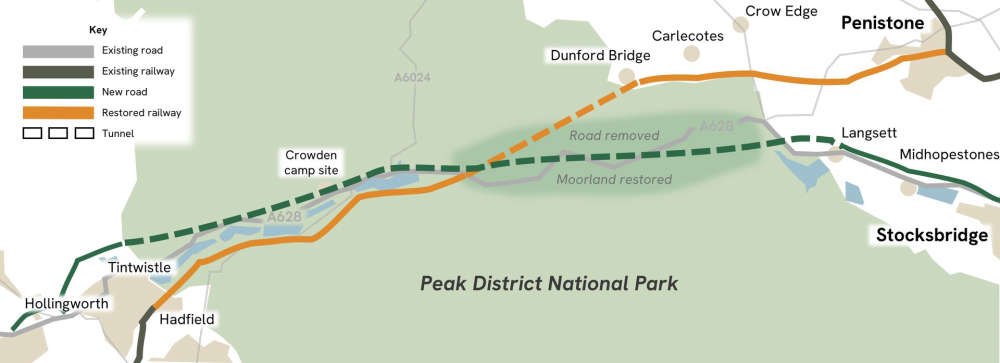
The idea to build a tunnel under the Pennines and connect Manchester and Sheffield resurfaced earlier this year. Now the steps towards it becoming a reality have been laid out.
An organisation called Future Works has devised a strategy to build a 14-mile tunnel beneath the Peak District mountains. The scheme is estimated to cut journey times between Manchester and Sheffield by 30 minutes and take traffic away from the National Park.
This comes 10 years on from when the government originally looked into the idea.
The Department for Transport’s (DfT) own report highlighted the benefits of the scheme would include a major environmental and economic boost. The report added that the scheme could be a ‘catalyst to explore further improvements in east-west connectivity, including linking the international ports on Merseyside and Humberside’.
However, the idea came to nothing as DfT decided it would be too expensive to complete – around £10bn. But Future Works believe it can be done for just £2bn.
The organisation, co-founded by Michael Dnes, wants to build the dual carriageway as well as a railway line – inspired by engineers who’ve done similar work in Norway. The Norwegians built the world’s longest road tunnel, the 24.5km Lærdal in Norway, for around £130m.
Despite the excitement of Future Works seemingly bringing the project back to life, the idea remains just an idea. The local MP, Jonathan Reynolds, has long advocated for better transport connectivity around the eastern corner of Tameside.
The villages of Hollingworth and Mottram have long been the victims of queueing traffic through their centres. They are right at the crossroads on Tameside and Derbyshire, where the Woodhead Pass and Snake Pass meet the Greater Manchester road network.
Mr Reynolds was instrumental in securing the Mottram bypass scheme currently under construction. But he believes Future Works’ plan now needs to undergo work to understand if it is actually deliverable and the actual benefits it could bring.
Jonathan Reynolds, MP for Stalybridge and Hyde, said: “Residents in Hollingworth have been waiting for years to see real progress on the issue of traffic passing through the village, so any credible proposal that could reduce congestion and improve connectivity deserves to be looked at seriously.
“I’ve been keen to support Future Works by speaking to stakeholders, and the priority now is to undertake the detailed work needed to establish whether it can be delivered, how it could be financed, and what benefits it could bring to local communities and the wider region.”
The idea would see one of the current Woodhead tunnels, which currently transport electricity lines for the national grid, for the new road and railway.
Rather than using the standard British approach of a tunnel-boring machine, Future Works has looked into the drill-and-blast method applied to tunnels in Norway. This system replaces giant machinery with more traditional mining techniques, the natural strength of the rock and small expert crews.
Although this would not work in many areas of the UK, the expert teams believe this ‘drill-and-blast’ method could work in this area due to the geology of the Pennines. This is because the tunnels built in Norway go through mountains with a similar rock type.
The previous model of going for direct government funding through the Department for Transport never got going after appetite for big road projects waned, according to Mr Dnes. So his team believes the project could be funded by either big pension funds or the local authorities and paid back over time through tolls on the tunnel.
Mr Dnes explained that tolls could actually work out cheaper than paying for fuel costs to go around an alternative route, particularly if the vehicle is larger, such as a HGV.
A spokesperson for Future Works said previously: “High demand for the route means that the project could pay for itself, without the need for Westminster funding.
“Scandinavian tunnels are often owned by local councils, who recover the costs through tolls. Equally, northern pension funds have hundreds of billions in investment capital that could be mobilised to build the project.
“Many options exist – public, private and partnership. Future Works was set up by infrastructure experts Michael Dnes and Alex Griffiths, with a combined expertise in more than £100bn of infrastructure projects. They aim to create a shovel-ready scheme, and to bring this through the planning system faster than the 10+ year processes that have become the norm in UK planning.
“Work could begin before the end of the decade, with the road and railway open in the mid-2030s."
 Tameside restaurant named best Indian in Manchester
 Dodgy underpass closed by the council
 Sir Kevin Sinfield opens new buildings at Ashton Sixth Form College
 Tameside Beer Festival proves to be a big hit