

When it was created back in the 1970s, the 29.6 mile River Tame gave its name to the constituency it calls home. And today, it still a decision which breaks the mould in Greater Manchester.
All the other boroughs in the region take their name from a large town or place. And this is possibly one of the reasons some consider Tameside one of the lesser known areas of the city-region.
The nine towns of Tameside have very strong individual identities, which trickle into local rivalries in sports, culture and even who gets the most council cash.
And perhaps these are reasons why the massive facelift coming for the eastern borough has gone under the radar.
If you go to Hyde, the people there might tell you they ‘get nothing, but Ashton gets all the money’; then people in Ashton would say the same of Stalybridge.
In this case, Hyde residents would be right at the moment – Ashton is getting the lion’s share of the funding and redevelopment opportunities right now.
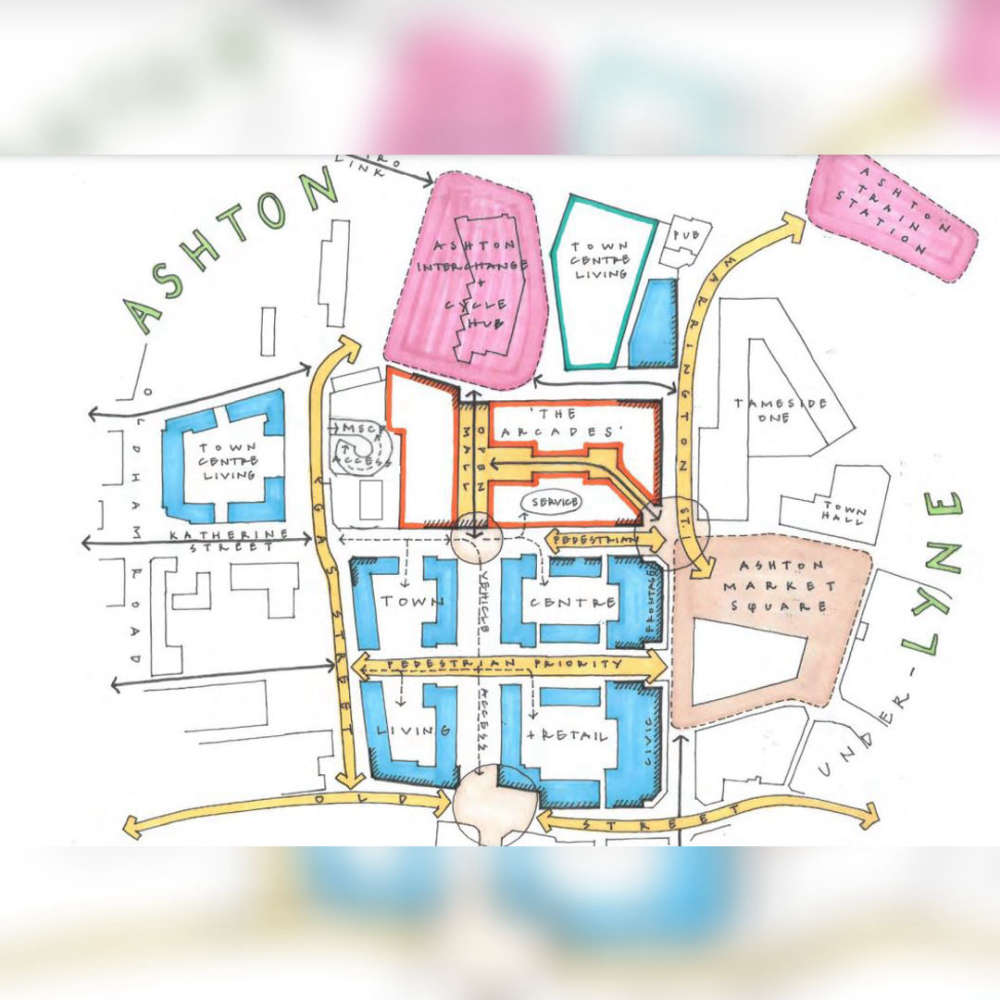
Back in May, Tameside council revealed they have put pen to paper and purchased the Ladysmith Shopping Centre in the heart of Ashton town centre. Heralded as a major step in a massive regeneration plan, the site is a central part of the authority’s strategy to bring key sites into public ownership – which it is hoped will allow regeneration to be delivered at pace and scale.
The shopping centre will continue to operate as normal under council ownership, but the future development looks likely to see the majority of the Ladysmith’s retail offer transferred to the Arcades shopping centre next door. The Ladysmith would be bulldozed to make way for 306 new homes under the proposals.
The Arcades would then become the central hub for shopping, with a cinema and leisure facilities earmarked for the first floor.
The 151,502 sq ft shopping centre is located centrally in Ashton town centre, adjacent to the Grade II-listed Town Hall, currently getting a revamp and reopening by 2030. The centre opens directly onto Market Square, currently being transformed by a £10.8m investment.
The acquisition of Ladysmith forms the latest milestone in the £1bn borough-wide regeneration that will reposition Tameside as one of the ‘UK’s best connected and most investable locations’. Backed by a dedicated Growth Unit, the council has secured over £250m of public investment to unlock a development pipeline that will deliver over 5,000 new homes, 3,000 new skilled jobs and vibrant, experience-led town centres designed for modern living.
But it’s all part of a grand plan being overseen by the town hall. The core strategy on driving forward Tameside is ‘Homes, Spaces, Places’ – the local authority’s vision for the borough’s growth over the next two decades.
A key component of this plan would be house building, with an extra 9,700 expecting to be constructed, and town centre regeneration. Tameside’s towns all have good transport connections with trains or trams in all of them with connections to Manchester and Yorkshire.
The aim going forward is to build on this major strength in transport, by building around these hubs that connect residents to a wider network.
Nicola Elsworth, director of strategic growth at Tameside council, said: “We’ve got nine towns and five town centres. Each of those is important to the council and it’s important residents feel that they are getting the most out of those centres.
“Each of those places is really unique, so the strategy around our town centres is bespoke to each town. When we think about housing growth, it’s about creating new good quality homes across 10 years.
“We have really big ambitions. I can’t talk about that without mentioning our Mayoral Development Corporation in Ashton, which is transport led. We are wanting to see services increasing into Ashton, which is currently one train an hour.
“In Ashton we have trains, trams and buses. So we’re the first borough to get Bee Network integration. We will be the best connected borough outside of London. It’s building on the strengths around transport connections.
“But it’s also about the council taking an active role in the delivery of redevelopment. Not only do we have a significant amount of government funding coming into our towns, we as a council are investing our money to further boost delivery to make sure our town centres do what they need to do for our residents.”
The council is keen to share the love when it comes to redevelopment. There are major residential developments and town centre makeovers currently coming to fruition in all corners of Tameside.
Recent examples include the 192-home affordable scheme set for Droylsden Marina and the 102-home residential scheme next to Stalybridge station. The latter will kick start the overhaul of Stalybridge town centre, which saw £20m investment from the government back for its Civic Hall and town centre as well as £11.1m for the redevelopment of its western edge (around the station) in recent years.
Denton also received £17m from central government, some of which will go to the regenerate Festival Hall. Public spaces around the town centre and Victoria Park could also benefit from significant improvements including improved pedestrian and cycling routes, and cycle parking.
Although Hyde and Droylsden have no town centre developments currently ongoing, they do both have individual masterplans to outline their future. However, due to the local authority not owning much land in these towns, these masterplans require greater private sector investment to get off the ground.
Despite this, Hyde is set to host the creation of two new villages on Godley Green. The proposal would see Godley Green Garden Village split into two halves by Godley Brook, each with its own centre, including up to 1,300 sqm of retail space, 1,600 sqm of commercial and 1,000 sqm for community use. In addition to 2,150 homes, green spaces, play areas and ‘biodiversity enhancements’ were also proposed.
Due to its sheer size, the Godley Green scheme would connect Hyde and Hattersley, which is also getting £20m funding from the Pride in Place programme. How the cash is spent is up to the local community, so the funding goes directly where it’s needed most.
What held Tameside back?
Considering the rural nature of the majority of Tameside’s landscape, a plethora of green space and good transport links – there is the question of why investment is only just coming.
The increasing pull of Greater Manchester for investment in general is one factor of course, but the housing and growth boss in Tameside, Coun Andrew McLaren, believes it’s down to the council getting their ducks in a row.
He says finally ‘Tameside is open for business’ because of their coherent strategy.
Andrew McLaren, deputy leader of Tameside council, said: “I think what Tameside offers now is a coherent plan. That is why we’re getting more and more private investment because people can see that everything is joined up.
“All this stuff talks to the borough strategy and council plan. That’s not just words, people are taking it much more seriously now. For instance, look at the Oryx industrial development on the edge of Dukinfield. That was settled very quickly – in six months it’s gone through planning, demolished and the site has been cleared. There is going to be a business area creating 250 high quality jobs.
“That was done quickly and succinctly because there was credibility behind it. That’s a good example of how the public and private sector are combining in Tameside.
“I can’t talk to what has gone before, because I wasn’t there (in executive roles). But I can talk about the really exciting stuff going on now.
“The developer, Oryx, said something that stuck with me, which is that in Tameside, particularly around the motorway corridor like Denton and Droylsden, there is a real pent up commercial demand that is now being realised because Tameside is open for business.”
The big obstacle now in the way of Tameside council is political instability. Following the local elections in May, Labour lost overall control of the town hall by losing all but one seat.
Reform UK nearly achieved a clean sweep in Dukinfield Town Hall, winning 18 out of 19 available council seats. It was a disastrous night for Labour, who dropped from 38 councillors to just 25.
They now run a minority administration held up by a collaboration with independents, some of which were previously involved in the Labour Party. If a similar scenario happens next year, a new political party could come in and alter their plans.
Coun McLaren admitted staying in power was going to be key to making sure all these plans come good.
The deputy leader added: “Political stability is vital. I was be disingenuous if I said political instability wouldn’t be an issue.
“We’ve got these growth units and masterplans set up. A lot of the work we’re doing is for the future.”
 Ruby wins Summer Reading Challenge prize
 331 families sign up for Hattersley Community Grocery
 Young gun takes Celtic hot seat
 Little Voices is expanding into Mossley